
MSU College of Arts & Letters Website Accessibility Assessment
Situation
Where & When:
This project took place at the MSU College of Arts & Letters (CAL) in East Lansing, MI, from January 2025 – May 2025.
Context:
The CAL website is used frequently by students, faculty, alumni, prospective students, and community members looking for program information, events, and artistic opportunities. However, the website fell short in accessibility, navigation, and overall user experience. Because MSU must comply with the Americans with Disabilities Act (ADA), CAL initiated a project to conduct a full accessibility and usability assessment to guide improvements.
In addition to compliance, CAL aimed to:
- Strengthen campus community participation
- Promote the work of students and faculty within the arts
- Help users find relevant information more easily
- Build a more professional and unified digital presence
Environment:
This was a collaborative, semester-long project within the CAL communications and digital experience teams. I served as the team lead, managing tasks and ensuring a complete assessment.
Team Members:
- Role: Project Manager
- Team Size: 3
- Additional Team Members: Two classmates who supported general research, data collection, and discussions
Task
Assignment Overview:
Our group was tasked with completing a comprehensive accessibility and user experience evaluation of the CAL website. The goals were to identify accessibility failures, improve overall navigation, and suggest design changes that align with ADA requirements and best practices in digital accessibility.
The project’s core objectives included:
- Accessibility: Identify WCAG-related issues involving color contrast, readability, keyboard use, assistive tech, and navigation
- Website Traffic & Community Building: Improve the site’s ability to highlight artistic work and campus events
- Navigation: Help visitors locate important information quickly, with a cleaner layout and stronger information hierarchy
As a team, we explored what needed improvement across content layout, visuals, accessibility, and user pathways.
My personal focus areas included:
- Conducting a comparative analysis of peer university websites (UMich Arts, OSU Arts, MSU Athletics)
- Leading the accessibility testing and tool-based evaluations
- Synthesizing findings into actionable recommendations
- Designing Figma prototypes that reflected our proposed improvements
Key Responsibilities:
My primary responsibilities included:
- Leading the team and coordinating weekly progress
- Conducting 15+ accessibility and UX tests
- Performing comparative research across three major university websites
- Documenting issues related to readability, contrast, navigation, and assistive tech
- Compiling findings into a clear Google Slides presentation
- Helping build a full recommendation plan, including visual examples and priority levels
Direction & Oversight:
The project was assigned and supervised by the Director of Marketing & Communications of MSU Arts, who provided:
- The project scope and accessibility expectations
- Feedback during the research and design phases
- Final approval before we submitted the deliverables to CAL’s web team
Action
Planning:
To begin the project, I led the team through:
- Reviewing the current site structure and analytics
- Identifying high-impact user flows
Meeting with the Director of Marketing & Communications to clarify:
- Accessibility benchmarks (WCAG 2.1 AA)
- Website goals and user groups
- The scope of the assessment and deliverables
These discussions helped structure our testing plan and ensured alignment with CAL’s priorities.
Initial Design, Research, & Test Structuring:
I guided the group through setting up:
- Structured testing scenarios
- A checklist for accessibility tools
- A shared document for tracking user behavior and issues
I personally conducted the comparative research with UMich Arts, OSU Arts, and MSU Athletics, analyzing successful design elements such as color usage, navigation styling, homepage structure, and branding integration.
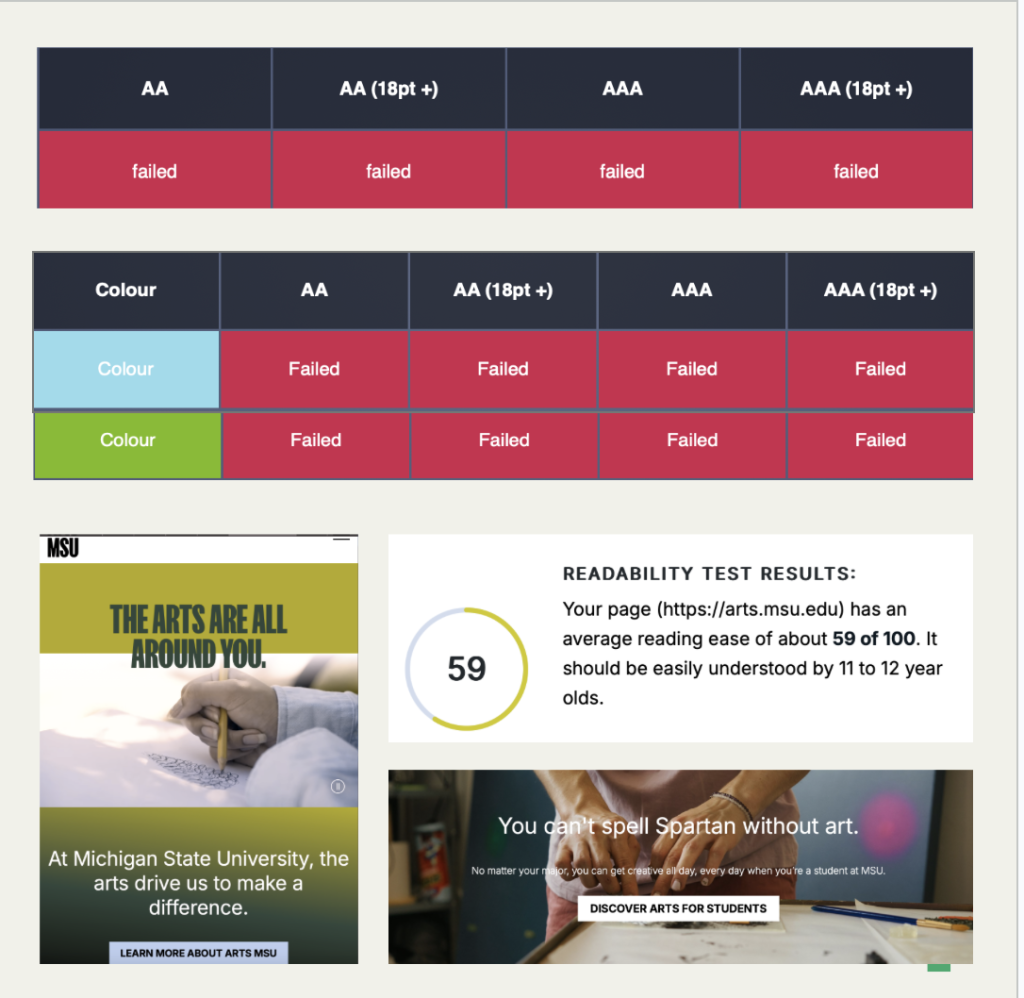
Our team then performed accessibility testing across multiple tools, where I led the evaluation of:
- Contrast ratios
- Readability scores
- Keyboard navigation
- Touch target sizing
- Menu and dropdown accessibility
- Screen-reader compatibility
- Section clarity and discoverability
This testing revealed major accessibility failures that shaped our recommendations.
Visual Layout, Prototyping, & Documentation:
After consolidating findings, I:
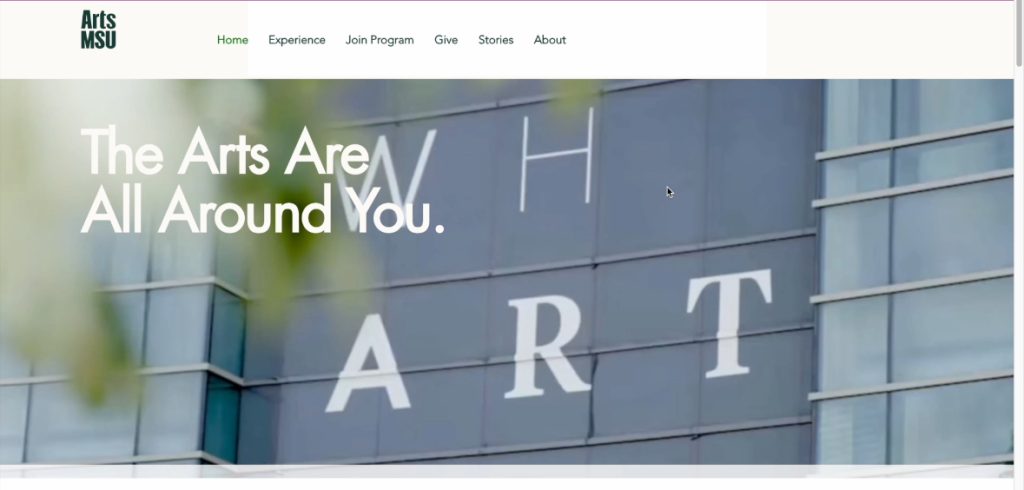
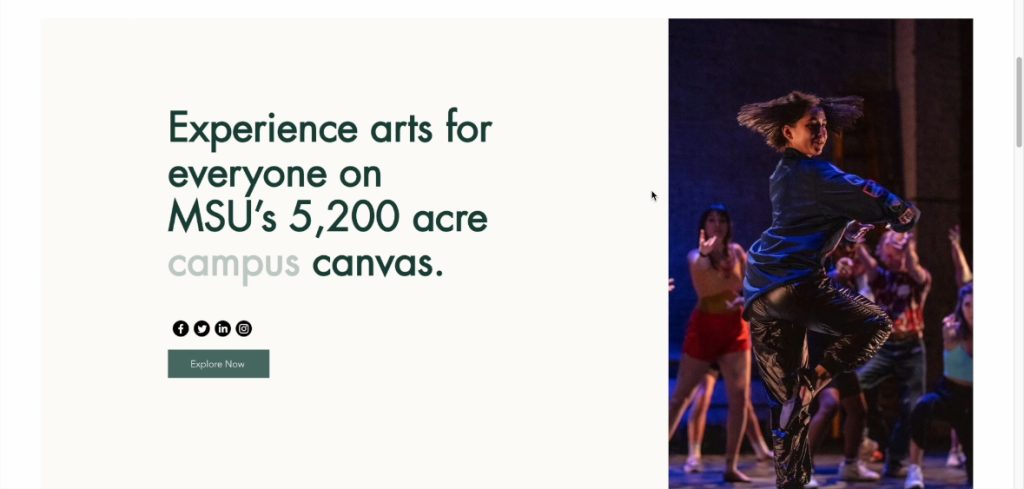
Created Figma prototypes reflecting:
- A cleaner homepage
- A more accessible color scheme
- Larger, more inclusive clickable elements
- Clearer section labeling and navigation structure
- Removal of dropdowns
Designed a clear Google Slides presentation that:
- Organized accessibility issues
- Included examples from peer institutions
- Highlighted before-and-after visuals
- Provided detailed, actionable recommendations
I ensured all visuals aligned with MSU’s identity and accessibility standards.
Prototype Snapshots
Finalization & Handoff:
The final deliverable included key improvements such as:
- A larger, more accessible background video
- A subtle, readable color palette
- A simplified and less overwhelming homepage
- Improved navigation hierarchy
- Enlarged touch targets
- Removal of inaccessible dropdown menus
After reviewing with the Director of Marketing & Communications, our team incorporated final adjustments and handed the full package to CAL’s web team.
Result
After approval, the project deliverables were adopted by the CAL web team as the foundation for future updates. The assessment provided a clear roadmap for improving the website for the 200+ monthly users who rely on it.
Key Outcomes:
- CAL gained a detailed understanding of accessibility failures and how to fix them
- The 3-person team provided a strong, structured plan for ADA compliance
- Our prototypes accelerated redesign decisions
- The final recommendations improved the visual hierarchy, clarity, and inclusivity of the site
The project strengthened CAL’s ability to support MSU’s artistic community
Personal Takeaways:
Through leading this project, I learned:
- How to manage a small team through a UX/accessibility research project
- How to perform in-depth usability testing with assistive technologies
- How to translate research into clear, actionable design solutions
- The value of university benchmarking in shaping design strategy
- That accessibility improvements dramatically enhance user experience for everyone